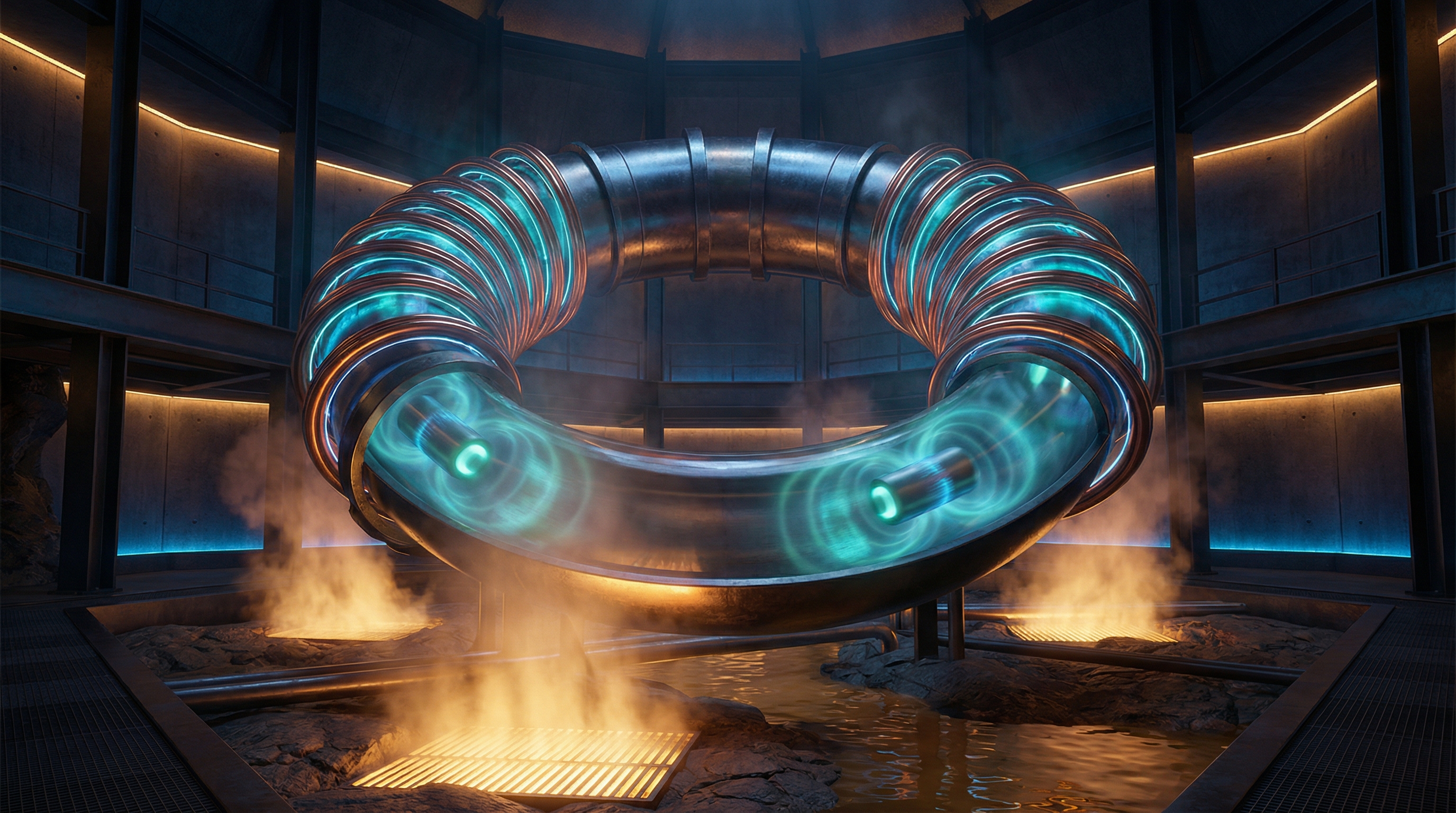
The Geothermal Magnetic Generator produces electricity from temperatures so low, no turbine on Earth can touch them. No blades. No rotors. Just magnets, physics, and the heat beneath your feet.
Conventional geothermal turbines require fluid temperatures between 180°C and 350°C. They break even financially around 140°C. Below that threshold, the well is considered uneconomic.
But Earth doesn't care about turbine specifications. The vast majority of accessible geothermal heat sits in the 100–170°C range — a temperature band that today's technology simply cannot profitably harvest.
Every year, billions of dollars in clean, baseload energy go untapped. Not because the resource isn't there, but because the conversion technology was designed for a different era.
This temperature band holds the majority of Earth's accessible geothermal energy. Conventional turbines cannot operate profitably here. The GTMG was designed specifically for it.
Hot fluid from a geothermal well — steam, brine, or CO₂ — enters the system under natural pressure.
Pressure drives magnetized slugs around sealed toroidal tubes. The slugs levitate magnetically — zero contact, zero friction.
As magnets pass through copper coils, electromagnetic induction produces current. The same principle as any generator — without the turbine.
Power electronics aggregate output from hundreds of parallel channels into clean, dispatchable, grid-tied electricity.
Profitably converts geothermal energy at temperatures where turbines can't break even. Opens the entire low-grade resource base.
36% more efficient than conventional turbines at the same temperatures. More electricity from every unit of thermal energy. Higher margins per well.
No turbine overhauls. No rotor balancing. No blade erosion. Modular design means partial outages never take the plant offline.
Start small, grow incrementally. Add capacity without replacing equipment. Phased capex reduces risk and matches revenue growth.
Sealed channels isolate components from abrasive brines and scaling minerals. No exposed blades means dramatically lower maintenance.
Hundreds of independent conversion channels. If one fails, the rest keep generating. Hot-swap modules without shutting down the plant.
| Factor | Conventional Turbines | GTMG |
|---|---|---|
| Min. Operating Temp | ~180°C (breakeven ~140°C) | 110°C 70° lower |
| Efficiency | Up to 11% | Up to 15% +36% |
| Annual Uptime | ~90% | 97% +7 pts |
| Moving Parts in Fluid | Turbine blades (erosion risk) | None (sealed channels) |
| Single Point of Failure | Yes (one turbine) | No (parallel modules) |
| Scaling | Bigger turbine (step change) | Add modules (incremental) |
| Maintenance | Turbine overhaul, rotor balancing | Module swap, no specialized tooling |
| Installation | Heavy cranes, precision alignment | Repeatable skids, constrained pads OK |
| Grid Services | Limited ramp rate | Fast response via power electronics |
| Working Fluids | Clean steam preferred | Steam, CO₂, brine, mixed fluids |
The GTMG doesn't fight for the same 7% of geothermal that turbines already serve. It opens the other 93% — the vast majority of Earth's geothermal energy that has been economically inaccessible until now.
Generates $0.7–2.3 billion in annual profits using conventional turbine technology at high-grade sites.
Wells drilled and characterized, but temperatures too low for turbines to operate profitably. Stranded assets.
Low-to-mid temperature resources that become economically viable with our technology. The single largest untapped clean energy resource on Earth.
Magnetized slugs float inside the tube with 0.5–10mm clearance. Zero wall contact during operation. Near-zero friction and wear. Passive and active centering systems maintain alignment.
Direct steam jets push slugs via pressure face, or external magnetic pistons couple through the tube wall without any fluid entering the slug chamber. Choose per site conditions.
Every conversion channel is fully sealed and independent. Sensitive magnets and coils are isolated from corrosive brines, mineral scaling, and non-condensable gases.
Per-module sensors enable predictive maintenance and real-time optimization. Power electronics provide fast grid response for frequency and voltage services. Native microgrid support.
Works with geothermal steam, supercritical CO₂, hot brines, and binary working fluids. Sealed operation reduces parasitic losses from gas handling and venting.
Closed-loop tube tracks allow continuous slug circulation. Multiple slugs per tube, multiple tubes per array. Shared manifolds and electrical collection bus for scalable output.
Full patent covering toroidal tube architecture, dual propulsion methods, magnetic centering, multi-tube arrays, and 10 specific claims.
Python-based models confirm magnetic centering stability, train control, power induction scaling, and propulsion trade-offs. Latest runs showing improved efficiency over initial patent models.
Active partnership with the University of Illinois Urbana-Champaign POETS Research Lab for independent validation using COMSOL/ANSYS simulation tools.
Thermofluid and electromechanical modeling across temperature cases (170°C, 180°C, 200°C). Materials screening, reliability modeling, and performance maps.
Single-channel prototype for physical validation of magnetic centering, propulsion, and power induction. Then scale to small multi-tube array demonstration.
We're looking for investors, research partners, and industry collaborators who see what we see: the biggest untapped clean energy resource on the planet.